A retired History and Politics high school teacher (1978-2008). Former Publisher/Managing Editor of The Beat Magazine (2009-2014). Freelance Writer. Proud Grandfather.
Funny, isn’t it, how a few of the things you learned in high school (take THAT, Paul Simon) really do stick with you. When I knew I had the privilege to attend opening night of 12 Angry Men, a drama that is part of this year’s Drayton Entrainment line-up, I recalled a short essay by G.K. Chesterton – “Twelve Men”. It argued with great charm that having “professionals” decide on cases of law would inevitably lead to jaded and repetitive trials and verdicts. His last words have rung in my ears for more than 60 years:
“When it
wants a library cataloged, or the solar system discovered, or any trifle of
that kind, it uses up its specialists. But when it wishes anything done which
is really serious, it collects twelve of the ordinary men standing ’round. The
same thing was done, if I remember right, by the Founder of Christianity.”
What a beautiful ideal…and yet this marvelous
play is a subtle reminder that the rights embodied in the U.S. constitution
require far more than men “standing ‘round” to insure that justice is done in
the courts. Canada shares the legal view of “reasonable doubt”- and the play
shows what a sacred and precarious position this is. As our Supreme Court stated
in 1997, “A reasonable doubt is not an imaginary or frivolous doubt. It must
not be based upon sympathy or prejudice. Rather, it is based on reason and
common sense. It is logically derived from the evidence or absence of
evidence”.
In the stage version of this play, director
Marti Maraden, set designer Allan Wilbee, the whole backstage crew- and twelve
of the finest actors assembled in Canada – I am certain of that – let the play
trust in its innate merits. Reginald Rose’s script began as a TV play in 1954, was
adapted to a play in 1955 and became a film (with Henry Fonda as Juror #8) in
1957. Of course, as decades progressed, directors have tried making the jury
mixed in race, colour, and gender, but the brilliant Drayton production crew
have resisted muddying the power of this play. The actors are all male, they
still have only numbers, not names, and they utter some of the best dramatic dialogue
you will ever hear on stage.
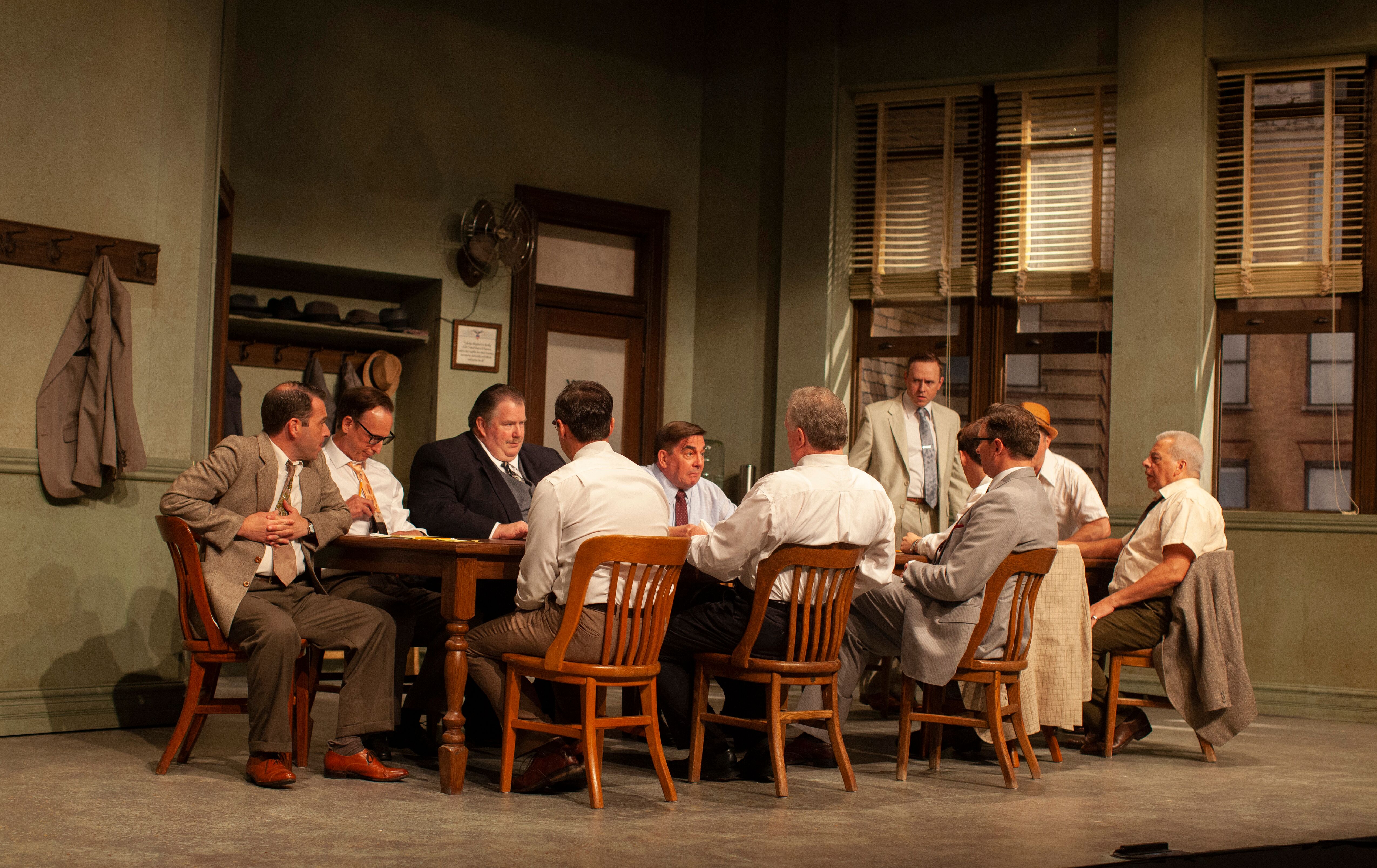
The set recreates a jury room of the 1950s-
mottled institutional green, not air-conditioned on the “hottest day of the
year”, and spare enough to create claustrophobia on a stage that also has a
brilliant revolving portion to make the washroom part of the set. When I first
saw the table for twelve set squarely across the stage, four jurors’ backs to
the audience, I wondered how this breaking of the 45-degree rule (is there such
a thing?) would work.
No problem for a director as gifted as Marti
Maraden. The table remains static- like an unbreakable rule, amendment, or
expectation- on the stage, while the actors carry out a kind of choreography
that demands their movement and results in character revelation more intense
than the movie version could do.
And how to give adequate recognition to that
cast- those numbered characters whom you will not ever confuse or forget if you
see this production. Juror #8, Skye Brandon, is an imperturbable citizen,
father, and architect- the gentle but persistent voice of reason who begins the
deliberation in what was almost a certain commitment of the 16-year-old
defendant to the electric chair. In most powerful contrast to him is #3,
Benedict Campbell, as the closed-minded juror whose personal failure as a
father underlies his unbreakable assurance that the boy is guilty. A lesser
actor might have striven to “beg” for likeability or sympathy in his final pathos-
but Campbell never does. I warrant you will recognize and remember Juror #3,
the garage owner whose references to “those” people and their innate faults
bring chilling reminders of recent presidential speeches. So, too, the accented
watchmaker, #11, who is never identified as a Jew but carries a fervent belief
in justice to his new home.
Instead of giving well-deserved praise for
every actor in the cast, I urge you to take advantage of this production before
August 3rd. The play is disturbingly timeless. It’s a reminder of how
demanding, fragile, and yet glorious this whole ongoing experiment with
democracy and human rights really is.
I went to see The Little Shop of Horrors at the Stratford Festival with some trepidation on Friday afternoon. I have seen some simply horrible productions of the play and wasn’t sure I could endure another.
Well, that all changed after the first musical number of this no-expenses spared production.
Great leads and supporting cast, great musical numbers, great sets and
costumes, and a wise-cracking Audrey II man-eating plant combine to make
The Little Shop of Horrors must-see theatre this season.
And, if you’re wondering, it’s kid friendly. I plan on returning with my granddaughters at some point this summer.
If theatre-goers can put aside whatever feelings they may have about what has been transpiring south of the border since November 2016, and then suspend their disbelief about the tarnished American Dream, Rocky: The Musical, now playing at the Huron Country Playhouse until August 3, is perfect summer theatre.
Based on the iconic 1976 Academy Award-winning movie Rocky
(now in its seventh incarnation) written by and starring Sylvester Stallone,
the play is making its Canadian premiere at the Drayton Entertainment theatres.
Indeed, the play encourages you to leave behind Trump’s
divisive America and take a time-trip back to 1976 Philadelphia with its garish
costumes, stark urban sets, music, seedy boxing gyms, and even seedier
characters.
Unless you have been completely cut off from North
American pop culture for the past 43 years, the play’s plot is all too familiar
and does not require much description here. It’s a classic rags-to-riches story
caught up in the so-called American Dream.
The play’s antagonist, Rocky Balboa portrayed by Alex Kelly,
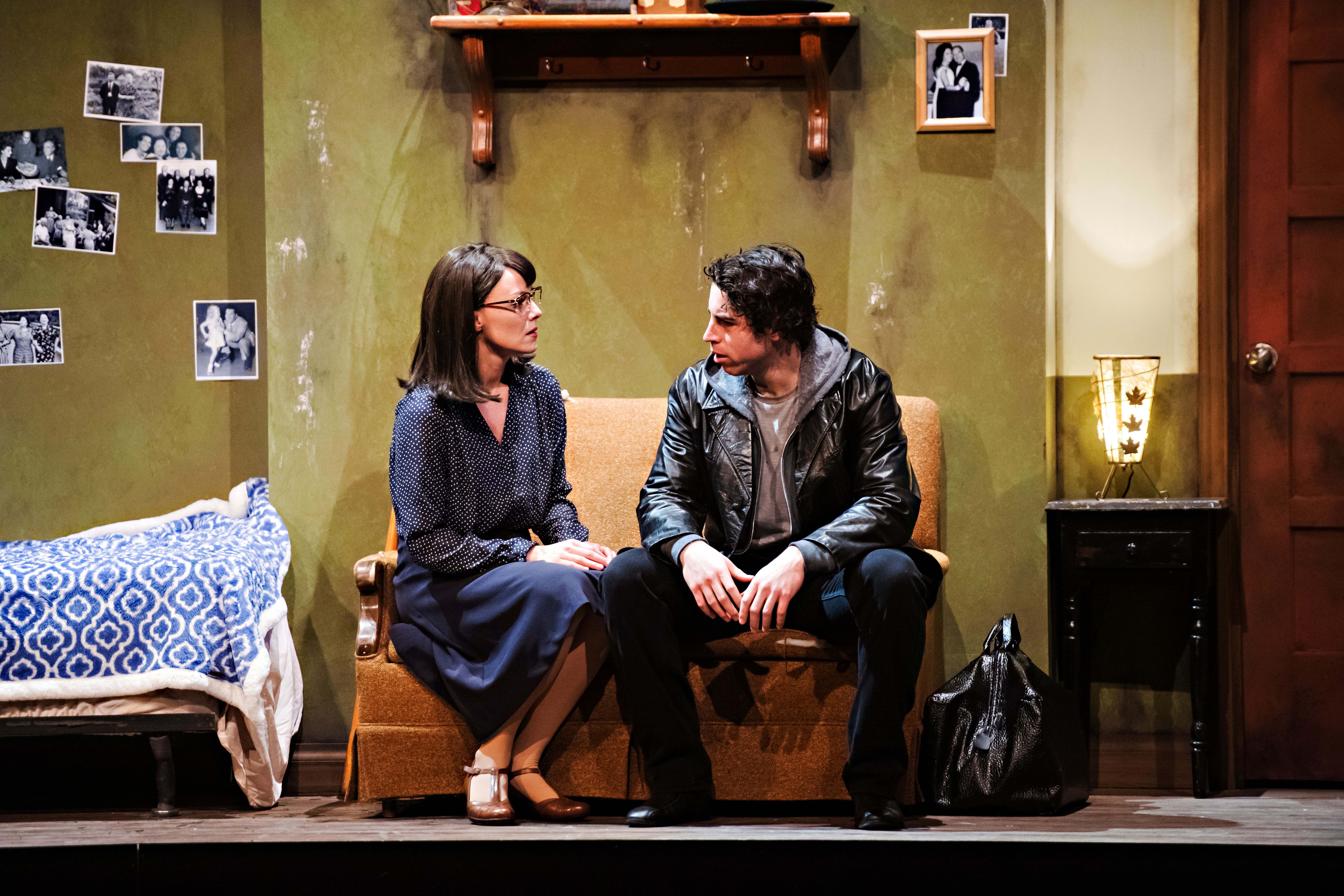
is a down and out Philadelphia boxer, frequenting Micky’s Gym and living in a
one-room dishevelled apartment. He makes his living collecting money for a menacing
local loan-shark.
When we first see him onstage, he is engaged in what
he later refers to as a “ham and eggs” boxing match against an equally
uninspiring opponent. Emerging as the victor, he earns $60 for his efforts and
heads for his locker seeking an after-match cigarette.
From this point on we are introduced to the play’s remaining major supporting characters including Mickey, his crusty Manager, portrayed convincingly by Lee MacDougall, Adrian, his shy and fragile girlfriend, portrayed deliciously by Drayton Entertainment favourite Jayme Armstrong (last seen as Millie in this year’s production of Thoroughly Modern Millie) and Paulie, Adrian’s overprotective alcoholic brother played by another Drayton favourite Aaron Walpole, who brings an abrasive, but sensitive interpretation to the role.
Christopher James, making his Drayton debut, is
perfect as the arrogant and condescending Heavyweight Champion Apollo Creed.
The three Pet Store girls, played by Daphne Moens,
Marianne McCord and Jacquelyn French, add an ideal amount of comic relief
throughout the play.
Again, most patrons will know that, as a result of a series of serendipitous events, the underdog Rocky gets the opportunity to box Apollo Creed for the Championship on January 1, 1976, the year of America’s Bi-Centennial.
While he prepares to go the distance in the bout,
Rocky’s relationship with Adrian turns romantic and he sorts out his ambiguous
relationships with Mickey and Paulie.
To be sure, the play’s culminating boxing match
between Rocky and Apollo is what everything has been leading to – and Director
Alex Mustakas pulls out all the stops for the finale.
The match takes place on a full-sized boxing ring and
selected audience members are escorted on to the stage to watch the match in bleacher-style
seats. The boxers enter the stage from the back of the theatre with flashing
lights and much fanfare, giving the audience the impression it is witnessing a
real boxing match.
The match itself is brilliantly choreographed, a joint
effort between Fight Director Joe Bostick and Mustakas, with cheering and ring
announcer and Round Girls.
The audience feels the boxers’ exhaustion and pain as
the bout marches on to the pivotal 15th Round when Balboa and Creed
collapse into each other’s arms. A split decision is announced, and Creed is
announced the winner.
Rocky has gone the distance, won $150,000 and got his
girl.
Alex Kelly deserves many kudos for his performance. In
lesser hands, Rocky could have been a walking, grunting cliché. Kelly brings
the necessary swagger, Stallone-like guttural voice and sensitivity to the
role.
Jayme Armstrong’s Adrian emerges as a strong
stand-by-your man woman who comes out of her self-imposed shell during the
play.
The chemistry between Kelly and Armstrong on stage is
electric and their vocal duets are moving.
Strains of the Rocky Theme and Glass Tiger’s Eye of
the Tiger are heard throughout the play, while its musical numbers propel the
story along quite adequately. Music Director Michael Lerner and the pit band
capture the essence of the play’s themes and characters.
Kudos to Set Designer Brian Dudkiewicz and Costume
Designer Adrienne Pink for transporting the audience back to 1976.
In the end, Rocky: The Musical is about hope,
second chances, love and redemption. In these days of political divisiveness
and cynicism, it is a welcome 2 hours of escapist entertainment.
Over her 73 years, Kathy Smith has worn many hats.
She has been a counterculture hippie, a member of an
all-female rock band, a Yorkville social activist, a wife and mother, a single
working mother, a self-proclaimed Late Blooming Boomer, a freelance public
relations and marketing specialist, an adult educator, and, for a time, the
Director of Training and Development for Big V Pharmacies of Ontario.
These days, Kathy spends her time advocating for aging
Canadians and organizing activities for London’s Creative Age communities, helping a diverse network of neighbourhoods,
municipalities, institutions and nonprofit organizations secure resources to
start, grow and sustain creative aging programs, events and activities.
“Many people have drawn very defined lines between
work, voluntary activities, hobbies and leisure pursuits. I don’t seem to have
those fixed boundaries. Sometimes I do community work for no pay and sometimes
I get paid. I might travel for leisure,
but I also get paid as a tour guide. I offer art classes free of charge but I
sometimes research, develop and teach courses and charge a fee for service.
Along the way I navigate and negotiate depending on the circumstances,” says
Kathy.
Kathy remembers her childhood Hamilton Road East
London working class neighbourhood as a multicultural melting pot in which classmates
and friends were from different races, ethnicities and religious backgrounds.
“Most of us were poor but I didn’t really realize how
poor we were until I met new friends from other neighbourhoods. When I started
to compare our circumstances, I was absolutely stunned by their family life,
wealth and opportunities. I often felt marginalized. I felt like a nobody when
I desperately wanted to be accepted – a somebody.”
This feeling of being marginalized led to Kathy’s
early involvement with the creative arts.
“I think I got involved with the creative arts not
only to express my inner life but as my way out of a messed up family and
social circumstances,” says Kathy. “I think those tough formative years made me
resilient, creative, enterprising and accepting of others.”
The 1960s mantra was “Tune in, turn on and drop out” and
that’s just what teenaged Kathy did.
“Right after my 16th birthday, I quit school and
walked away as fast as I could,” she recalls.
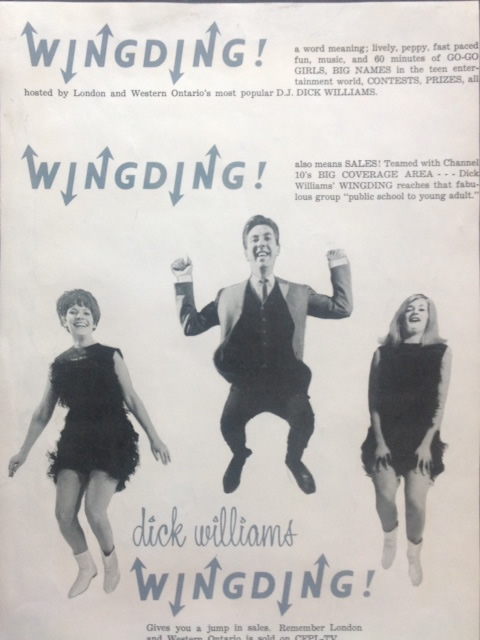
“I got a job as a go-go dancer for a local London
radio station and a TV show that featured area bands. In 1965, I was asked to audition
for a Toronto TV Show and an all female band. My bag was packed with my
survival essentials and years of hurt feelings. There was no turning back. I
was rebelling against my parents and the social values of the time. I vowed I
would never ever return to conservative, narrow minded and uptight London
Ontario…the town that forgot how to have fun.”
She didn’t get hired for the Toronto TV Show, but she
did end up in the all-female band called The Living Dolls in which she played
keyboards and learned some drums and bass guitar.
Kathy lived close to Yorkville in the Annex
Neighbourhood. In 1969 Jane Jacobs and the Annex Ratepayers Association were
busy trying to protect the historical neighbourhood from developers. Kathy
remembers it as an amazing and diverse neighbourhood with artists, musicians,
academics, the nouveau riche and old family money, too.
In 1966, Kathy came back to London to see her hometown
boyfriend, Grant Smith. Grant ended up moving to Toronto where he was offered
an opportunity to join a band called The Power which became known as Grant
Smith and The Power, an 8 piece R&B group.
“Grant’s group had a hit record, so I quit my band and
we ended up traveling through many American towns and cities that were
experiencing great unrest with race riots and protests. It was exciting and
kind of dangerous,” recalls Kathy. “We
got married in 1968. I became a mom in 1972. Everything changed for me when I
got pregnant and had my son.”
Following her divorce, Kathy returned to London in
1979. The move forced her to start all over again.
“As a high-school drop out and single mom, my
employment opportunities were very limited. I didn’t really join the ‘normal’
mainstream workforce until I was 30 years old. While most boomers experienced a
career or financial peak in their 40s and 50s, I didn’t have my career peak
until I was in my 60s. When my friends were planning to retire, I was just
getting fired up – a second wind, if you will,” Kathy recalls.
Partially by chance and partially by choice, she
became part of the gig economy with three main clients, mailing direct mail
flyers, organizing small special events, producing newsletters, fundraising or
anything promoting local businesses or organizations.
She taught adult night courses in Promotions and
Public Relations through Fanshawe College’s Part Time and Continuing Education
Department. She was a popular facilitator and her courses filled up quickly as
a result of her ability to come up with creative ideas, interesting topics and
course plans.
“My continuing education experience led me to my one
and only ‘real job’ with Big V Pharmacies of Ontario as Director of Training
and Development. I created a 26 part Management
Training Program using the case study method. It took me and a co-worker 3
years to do the research, develop the content, test the pilot programs and
implement throughout Ontario. Big V won
the very first Chamber of Commerce London Business Achievement Award and we
were runner up for the provincial award. That was an exciting time to be
involved with corporate or management training,” she recalls.
Despite her success, Kathy walked away from the Big V
position after 36 months, citing burnout and her dislike of leaving her son,
Kristan, alone while she was on the road.
“During my self-imposed sabbatical, I felt a strong
urge to paint – canvases, walls or anything I could get my hands on. A short
and planned break turned into a 10 year endeavour and I somehow found creative
ways to make a modest living along the way. I didn’t make a lot of money, but I
could focus on my son and we were happy.”
In 2007, Kathy got involved with the Creative Age
movement after attending an online seminar presented by Dr. Gene Cohen. Cohen
demonstrated that participation in activities that foster creative engagement
and skills mastery in a social environment has positive psychological, physical
and emotional health benefits for older adults. It gave Kathy a new focus in
life.
“After mid-life, I tell people they can look forward
to Creative Age and not old age. It is a positive approach or mindset to the
reality that we all get older. In my work I focus on creativity in the broader
sense and I do make more personal time to fulfill my own urges for creative
self expression in everything I do. My colleague, Pat Spadafora the former
director of the Sheridan Centre for Elder Research, said it best: ‘We are
freeing ourselves of limiting beliefs about aging and embracing the
reality that individuals continue to grow, learn, and contribute to their
communities throughout the life journey.’”
Unquestionably, Kathy has been the driving force
behind London’s Creative Age movement and community activities.
In 2009, she organized a unique year long creative
aging program for residents and day program participants at the Dearness Home.
She also volunteered her time to help the City of London receive its first Age
Friendly Community designation from the World Health Organization.
From 2010 to 2013, she developed and organized a
research project to identify late career transitions and income earning
opportunities for older workers.
“We knew that 75 would eventually become the new 65,”
she says. “Many will continue to delay retirement or not retire at all.”
From 2013 through to 2017, she worked with volunteers
to provide creative aging programs and events for adults 55+ in various
neighbourhoods through the London Public Library branches.
During that time, she also developed community
awareness campaigns including, social media and presentations and events
targeted to arts, health and housing organizations in London and area.
“The key to developing community capacity for creative
aging programs is to train volunteers, artist instructors and adult educators
to work with a new generation of older adults. Through the London Arts Council,
we developed a training program for 12 London Artists in Residence and had them
offer programs to long term care facilities, hospitals, retirement homes and
seniors centres. I still work with municipalities and communities to develop
creative networks and programs for older adults. The next Creative Aging
Training Programs will be offered in Thames Centre this summer. Professionals
from Middlesex County will be invited.”
Kathy’s accomplishments have not gone unrecognized.
She has been named to the City of London Mayor’s Honour Roll, received the
London Council for Adult Education’s Adult Educator’s Award, and in 2016 she
was recognized by the Ontario Minister Responsible for Seniors and the
Lieutenant-Governor of Ontario for her volunteer contributions to raise
awareness to promote cross-sector initiatives for seniors in the London region.
Somehow, throughout all of this community activity,
she has still found time to pursue her own artistic muse and explore her own
curiosities.
“I have many interests and creative pursuits. I still
paint, play music, write, perform and teach.
It’s all creative. A few years
ago, we started a group called The Rhythm Sisters and performed concerts at the
London Music Club and Wolf Performance Hall for a year or more. We keep saying
we’ll have a reunion, but I don’t think it will happen. It’s a whole lot of
work and it’s expensive to develop a one hour show,” she says.
What does the future hold for Kathy Smith?
“My
focus will be shifting to creative housing options and aging at home services.
I will continue to help organizations secure the resources they need, both
financial and human, to do community development projects. I have more requests
to do public speaking and professional development presentations. For the next
five years, it will be my goal to connect and empower older adults to work
together to develop innovative and affordable solutions to address their needs
in housing and home support programs. When my son returns from Europe, I will
probably assist him with his plan to start his new business and then I’ll
probably just work for him in some very limited capacity.”
Mentoring and coaching other women is an area of
particular interest to Kathy.
“As more women are reaching their middle years, they
are thinking about late career changes or making other plans for the second
half of their lives. I am often asked to provide presentations about my
experiences and ideas. As a creative ager I explore, engage and connect and I
plan to remain engaged as long as I am needed or as long as I am able to
contribute something needed or valued.”
“Career, work, social, civic engagement and leisure
have always been rolled into one thing. I just can’t see ever wanting to give
anything up just yet. When it comes to
creative aging, I consider myself my own case study,” says Kathy.
“Everyday life still amazes me!”
You can contact Kathy for more information about London’s
Creative Age communities and activities through her website: http://creativeage.ca/
Kevin Bice always knew
he was going to be an artist.
“I had been so immersed
in art that it seemed a foregone conclusion that I would end up in the arts
somehow. That I ended up as a teacher was
surprising given my natural shyness,” says the 72-year-old London born and
raised artist and former teacher.
Kevin’s father, Dr.
Clare Bice, was a nationally well-known artist, illustrator and writer of
children’s books and art gallery director.
In 1940 he was appointed at the first curator of the new London Art
Gallery, a post he held for over 30 years.
Kevin says he was
constantly surrounded by the arts in various forms, including some very well
known artists like A.Y. Jackson, who were always around for gatherings or
dinners.
“I grew up regarding a
career and a life in the arts as a natural, almost ordinary outcome rather than
the ‘elite’ activity that some see it as,” says Kevin.
As a student at London
Central Secondary School, Kevin was busy with school shows, the yearbook and
student newspapers – in all cases, as an artist or designer. He says it was a good personal experience since
“I was painfully shy as a kid and theatre allowed me to connect with others and
to express myself publicly.”
When Kevin arrived at
Western University as an English major, he got involved in the Gilbert and
Sullivan Society.
“I didn’t see myself on stage, so I designed the poster and worked on publicity. However, over the next three years, I did end up on stage in the chorus and then backstage as the producer of two shows,” Kevin recalls.
Kevin’s high school art
teaching career began in Sault Ste. Marie where he was asked to initiate an art
department in his fiancé’s school when her principal learned he had a second
teachable in visual art.
“This was all the more
extraordinary since I had one university art course under my belt when I left
Western, but I had never taken art in high school,” jokes Kevin. “When I
returned to London in 1976, I was asked if I would start an art program at my
old high school, London Central S.S.”
Kevin taught art at
five London high schools including Montcalm, Central, Lucas, Saunders and
Oakridge. He says that teaching art,
especially from no real formal background in art education, was extremely
important to his career as an artist.
“Struggling to find
ways of drawing the creative spirit out of students helped me to find my own
directions. I was also heavily involved in theatre and performance at all the
schools I taught in. I am particularly proud of the large original school shows
that I produced and helped write at Montcalm and of the Arts Festivals I
organized at Lucas and Central,” says Kevin.
Kevin describes his
artistic style as “whatever comes out.”
“My work is mostly
representational. I have been strongly
influenced first and foremost by my father,” Kevin says. “Other influences are the European
Impressionist painters, the Group of Seven and other Canadian “plein air”
painters like William Blair Bruce, Bonnard for colour and subject matter,
Andrew Wyeth for composition, Rauschenburg for experiment and subject, Henri
Matisse, Edward Steichen and Henri Cartier Bresson photographers, Winslow Homer
and especially John Singer Sargent.”
“When I paint outdoors,
I first look for a comfortable place to be.
After that, I get immersed in the play of light on the subject for about
two hours of very concentrated time,” says Kevin. “In the studio, the process involves a lot of
‘fiddling around’. I spend a lot of time
just wandering through my large collection of art books. I have a number of ‘idea books’ where I keep
idea fragments, tiny sketches, clippings – anything that can stimulate an idea
for a work. Once I begin a larger studio work, I try to have two or sometimes
three works on the go at the same time.
I also try never to finish a work without having something else in
progress. Beginning, at the start of the
day, with a blank canvas is really difficult.”
One of the collaborations he is most proud of is the 2008 The River Project.
“I was one of 19
artists who wanted to create a book and an exhibition that would encourage
London citizens and others from out-of-town to look at and celebrate the Thames
within the boundaries of the city. Accordingly,
after a year or so of sketching, painting and meeting, we published a book
which was entirely paid for by grants and donations. That allowed us to print 2600 copies of the
book which we then gave free to a number of non-profit local groups to use as a
fund-raiser.”
Kevin also co-founded
the annual London Artists’ Studio Tour with Lorraine Roy 26 years ago. The tour brings thousands of people, some who
might not normally go to art shows, into artists’ homes and studios. Over 220 London artists have been involved in
the tour.
These days, Kevin and
his wife Daphne do a great deal of travelling and he uses at least part of each
trip for sketching and gathering painting ideas. He has been asked to be the tour leader on a guided
South African art tour. He is also occasionally
asked to do workshops and talks on the artistic process.
“I have two fundamental
beliefs: That the arts are vital to the health of an individual and a community,
and that creativity is part of the definition of being human,” says Kevin. “The Creative Spirit is not confined to an
elite group. Art is not a frill.”
To be sure, London is blessed to have creative individuals like Kevin Bice.
Rick Young, July 2019
This article appears in the July/August issue of Aging Well Celebrating The Young At Heart magazine.










 Richard's Blog