“It went by fast, didn’t it? Twelve months. Just 12 months ago, you were right here, thinking about how 2025 would go, thinking about changes you were trying to make, things you were going to start, things you were going to stop.
Well?
It’s like that verse in the beautiful John Lennon and Yoko Ono Christmas song:
So this is Christmas
And what have you done?
Another year over
And a new one just begun
The first part of that haunts us a little. There was more we could have done. There were things we fell short with. There was life left unlived. It’s a little bittersweet and sad, isn’t it? A little disappointing, even shameful. But it’s that final line that has the hope in it—and the imperative.
We’ve been blessed with another go, or at least the start of another go. Will we take it? Or will we go on the same as we did before and before and before?
Marcus Aurelius had a powerful thought exercise that is worth trying here at the close of the year. Think of yourself as dead, he says. Imagine that your life has come to its end. Think about what you left undid. Think about the perspective this puts on things. Think about what you’ll regret, what you’ll wish you could do differently, what you’d say, what you wish you’d started and stopped. Now, he says, you’ve been given a second chance, so take what’s left and live it properly.
This is Christmas. What have you done? 2025 is over. But now 2026 is just beginning.
We are living just two millennia after one of history’s greatest philosophers walked the earth. This philosopher came of age in the Roman Empire, spreading a message of kindness, forgiveness, mercy, and duty. Through his life and legacy, he taught millions of people how to live, die, and better themselves while treating their neighbors with compassion. But his wisdom became controversial—a threat to the state—and he ultimately met his end at the hands of Roman centurions.
Even in his agonizing final moments, later immortalized in great works of art, he urged his followers to stay strong, live a good life, and forgive the Romans for their ignorance. In his bravery, he cemented his legacy forever.
This is the story of Jesus, celebrated worldwide today on Christmas.
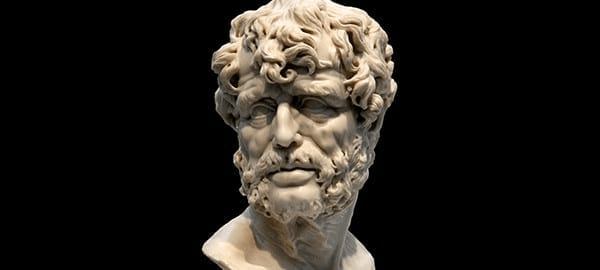
It is also the story of Seneca. Remarkably, these two figures lived nearly parallel lives, with many sources suggesting they were born in the same year. While exact dates remain uncertain, it is undeniable that two of history’s most profound thinkers lived at the same time.
Even more striking are the overlaps in their teachings. This Christmas morning, it’s worth reflecting on the shared wisdom of these extraordinary lives.
On the Golden Rule:
“Thou shalt love thy neighbor as thyself.” — Jesus
“Wherever there is a human being, there is an opportunity for a kindness.” — Seneca
On getting revenge:
“If someone strikes you on the right cheek, turn to him the other also.” — Jesus
“It is a petty and sorry person who will bite back when he is bitten.” — Seneca
On tending to one’s own garden:
“And why do you look at the speck in your brother’s eye, but do not consider the plank in your own eye?” — Jesus
“You look at the pimples of others when you yourselves are covered with a mass of sores.” — Seneca
On material possessions:
“Do not store up for yourselves treasures on Earth, where moth and decay destroy, and thieves break in and steal…No one can serve two masters. He will either hate one and love the other, or be devoted to one and despise the other. You cannot serve God and mammon.” — Jesus
“If my wealth should melt away, it would deprive me of nothing but itself, but if yours were to depart you would be stunned and feel you were deprived of what makes you yourself. With me, wealth has a certain place; in your case it has the highest place. In short, I own my wealth, your wealth owns you.” — Seneca
On living in the present:
“Therefore do not worry about tomorrow for tomorrow will worry about its own things. Sufficient for the day is its own trouble.” — Jesus
“Two elements must therefore be rooted out once and for all: the fear of future suffering, and the recollection of past suffering; since the latter no longer concerns me, and the former concerns me not yet.” — Seneca
The legacy, teachings, and wisdom of both figures have lived on far beyond their deaths.
This Christmas, marvel at the near-miracle of these two wise men—alive at the same time—whose suffering and teachings shaped a lasting legacy.
“You are afraid of dying. But, come now, how is this life of yours anything but death?” – Seneca, Moral Letters.
Seneca tells us an amazing story about an obscenely wealthy Roman who was carried around by slaves on a litter. On one occasion, after being lifted out of a bath, the Roman asked, “ Am I sitting down yet?” Seneca’s point was essentially: What kind of sad, pathetic life is it if you’re so disconnected from the world that you don’t even know whether you‘re on the ground? How did the man know whether he was even alive at all?
Most of us are afraid of dying. But sometimes this fear begs the question: To protect what exactly? For a lot of people, the answer is: hours of television, gossiping, gorging, wasting potential, reporting to a boring job, and on and on and on. Except, in the stricter sense, is this actually a life? Is this worth gripping so tightly and being afraid of losing?
“Many times, an old man has no other evidence besides his age to prove he has lived a long time.” – Seneca, On Tranquility of Mind.
How long have you been alive? Take the years, multiply them by 365, and then by 24. How many hours have you lived? What do you have to show for all of them?
The answer for many people is: Not enough. We had so many hours that we took them for granted. All we have to show for our time on this planet are rounds of golf, years spent at the office, time spent watching mediocre movies, a stack of mindless books we hardly remember reading, and maybe a garage full of toys. We’re like the character in Raymond Chandler’s The Long Goodbye: “Mostly, I just kill time,” he says, “and it dies hard.”
One day, our hours will begin to run out. It would be nice to be able to say: “Hey, I really made the most of it.” Not in the form of achievements, not money, not status – you know what the Stoics think of all that – but in wisdom, insight, and real progress in the things that humans struggle against.
What if you could say that you really made something of this time that you had? What if you could prove that you really did live [ insert number] years? And not just lived them, but lived them fully?
(Source: The Daily Stoic: 366 Meditations on Wisdom, Perseverance, and the Art of Living.)
by Richard Young, Publisher & Content Manager, The Beat Magazine 2025.
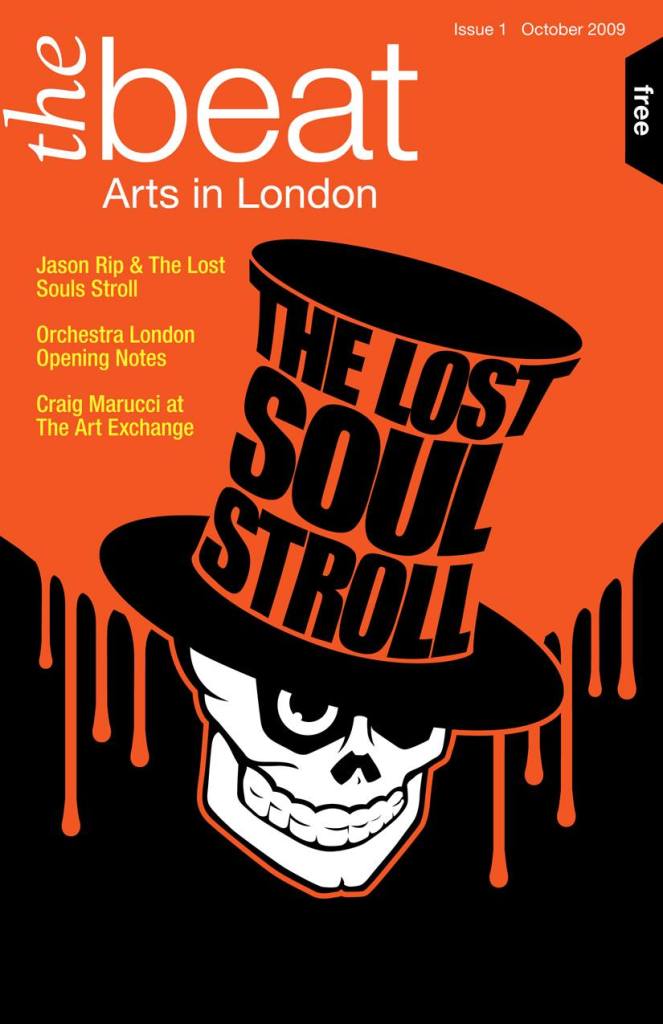
(Pictured: The Beat Arts In London, Issue 1, October 2009. Cover Art by Lionel Morise)
After a nine-year hiatus, I recently revived The Beat Magazine, an independent arts magazine I founded and published from 2009 to 2013, as The Beat Magazine 2025 website.
Since then, several of my peers and contemporaries have asked me one simple question: Why?
It’s a question I have asked myself many times over the last few weeks.
First and foremost, my reason for doing so is my humble attempt to make up for the lack of local arts and culture coverage in the mainstream media over the last several years. Frankly, I think this is criminal in a city the size of London. London and area creatives deserve better.
As one of our volunteer writers, Dawn Lyons, sums it up:
“London’s arts scene is alive with talent, creativity, and passion. It’s full of amazing artists across disciplines who continue to create, perform, and inspire, often without the recognition they truly deserve. I see The BeatMagazine 2025 as a way to showcase that energy and help connect people in the community with the incredible work happening around them.”
Much like the former print publication, the website provides timely, informed local arts news and commentary, and previews and reviews of local arts events. It also includes profiles of the area’s creatives and arts and culture venues. It is ad-free, and subscriptions are free.
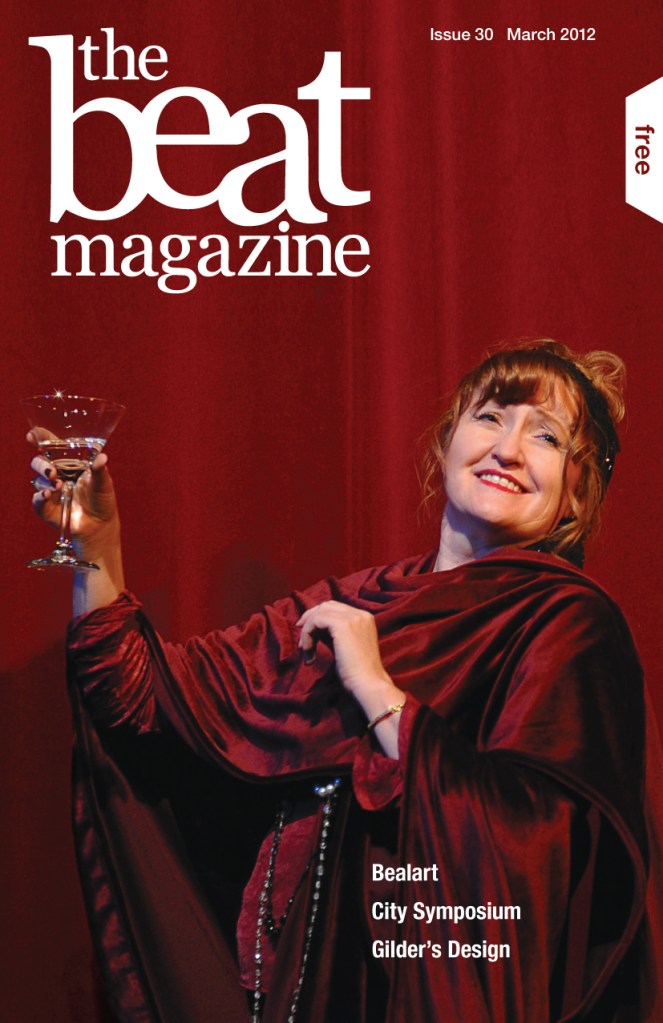
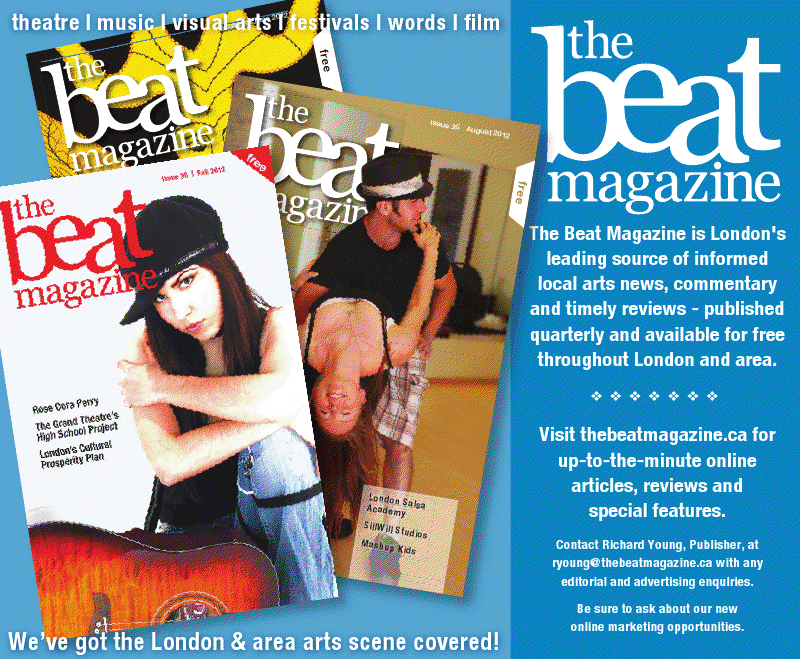
(Pictured: The Beat Magazine, Issue 30, March 2012. We featured Ceris Thomas on the cover. Ceris was appearing in The Drowsy Chaperone, then playing at the Palace Theatre.)
Second, simply because I want to.
Since the print magazine folded in the summer of 2013, I have kept myself busy doing many things.
I wrote freelance for a variety of local print publications, including Lifestyle Magazine, Business London, London, Inc., Professionally Speaking (Ontario College of Teachers), Scene Magazine, and the Villager Group of community magazines.
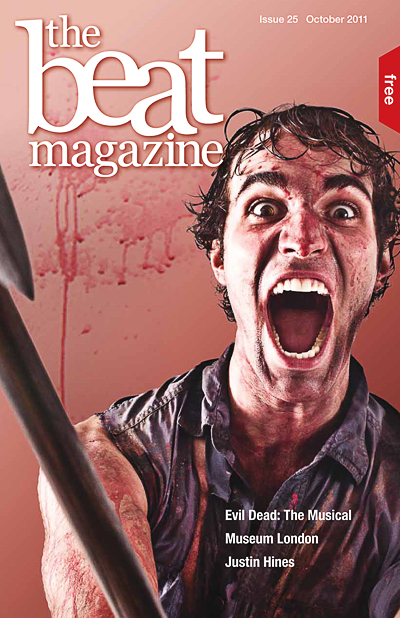
(Pictured: The Beat Magazine, Issue 25, October 2011. This cover featuring a cast member from Evil Dead: The Musical proved to be one of our most popular ones. We had difficulty keeping our stands stocked!)
I worked part-time/casually at a well-respected London Advertising & Marketing agency, writing copy about heavy industrial machinery. Talk about a learning curve! I thank owners Robert Adeland and Mina Thaler for their patience in teaching me the ins and outs of large cranes, dump trucks, excavators, and the like.
From December 2022 until August 2025, I was the Publicity and Program Department Head for Silver Spotlight Theatre, London’s theatre company that gives those 55 and older a chance to sing, dance, and perform on stage or backstage.
Most recently, I have served on the London Public Library’s Historic Sites Committee, the body that erects plaques around the city commemorating people and places of local historical significance. One project I take particular pride in is an Interpretive Sign Celebrating Wonderland Gardens’ Contribution to London’s Music History, which I prepared in collaboration with the City of London Culture Office. It will be officially unveiled on a date TBD.
(Pictured: The original Wonderland Gardens Outdoor Bandshell. Wonderland opened on May 24, 1935.)
That brings me up to the summer of 2025.
An unexpected medical diagnosis of Chronic Kidney Disease in July forced me to reevaluate many aspects of my life.
First and foremost, was changing my dietary and exercise habits. Gone are all processed foods, fast foods, and those with high levels of sodium and potassium. No more putting off going to the gym at least three times weekly.
Second, was relieving those things that cause me mental stress and unnecessary anxiety.
At my age (70-something), I decided that I want to fully re-engage with the local arts and culture community, rather than focusing on one aspect of it with my involvement with Silver Spotlight Theatre.
I also want to work at my own beck and call and not be accountable to others who may not always share my at times unbridled enthusiasm and relentlessness.
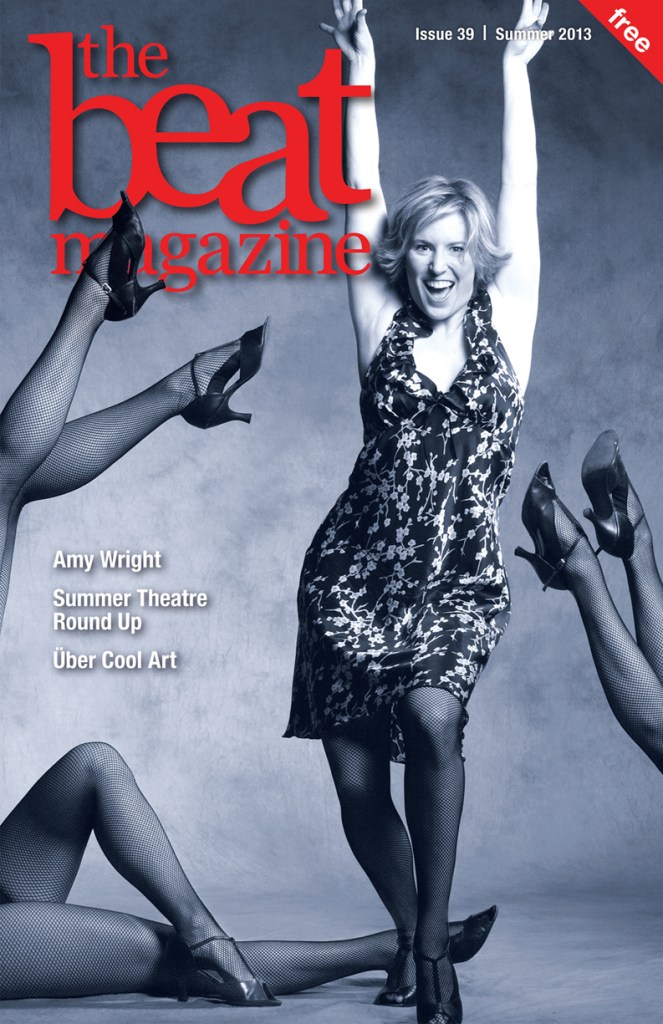
(Pictured: The final issue of The Beat Magazine, Summer 2013, featuring London dancer and choreographer, Amy Wright, on the cover)
In short, reviving The Beat Magazine seemed to be the best course of action to follow at this point in my life.
Has it taken up a lot more of my time than I thought? Hell, yes! But it’s my time and I love it.
Is there any financial return? Hell no! It’s strictly, to use the old cliche, a labour of love.
So, welcome to the new Beat Magazine in the form of The Beat Magazine 2025 website!
Let us know what you would like us to cover. Let us know if you would like to volunteer some writing about the local arts and culture scene. Let us know how we’re doing. What’s working and what’s not working.



 Richard's Blog