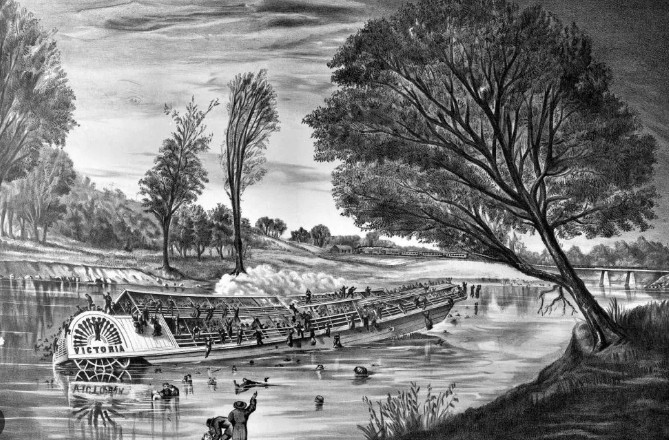

(Source: Canadian History Ehx)
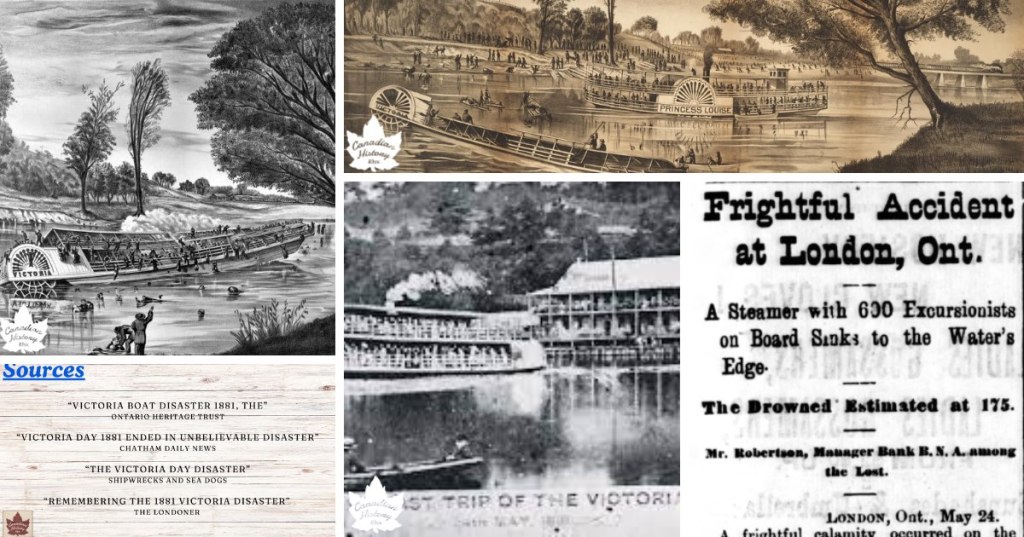
When 600 people crowded onto a boat in the Thames River near London, Ontario, on May 24, 1881, they expected a nice voyage to celebrate Victoria Day.
Instead, it became one of Canada’s worst maritime disasters that left nearly 200 dead.
This is the story.
In the 1870s, as London’s population grew, passenger boats began to appear that ran on the Thames River.
In 1878, the Forest City was launched, followed by the Princess Louise and Enterprise in 1879, the Admiral in 1880, and the Victoria that same year.
The Victoria was a paddle-wheel ship powered by a 60-horsepower boiler. She had two decks and ran 24 metres long. Built at a cost of $5,000, she could accommodate 300 people at full capacity.
Typically, Victoria Day was the busiest day for the ships on the Thames.
On May 24, 1881, the Victoria began transporting people along the river at 9 a.m. She made two round-trip river trips on the river twice before docking at London, Ontario, at 3:30 p.m. to reload with passengers with a 5 p.m. departure.
After the Forest City ran aground on a sand shoal, the Princess Louise aided in transporting passengers off it. This left the Victoria to ferry passengers to ports along the river.
Before long, the Victoria was dangerously overcrowded with people.
People boarding the overcrowded vessel didn’t seem to care about the number of people on the ship. The vessel sat very low in the water due to the weight of the passengers, but many passengers joked that the river was too shallow to cause a disaster.
Eventually, the captain refused to take on any more passengers. By this point, there were 600 people on the ship. Many were rowdy, causing a rocking of the vessel. To stop the voyage, the captain steered the ship to a sandbar near present-day Greenway Park.
At this same moment, two members of the London Rowing Club started to race each other on the river. Passengers on both decks of the Victoria rushed to the starboard side to watch, causing an imbalance. The ship lurched to starboard and then to port.
This caused the boiler to break from its mountings on the lower deck. As it tumbled, it sent scalding hot water over several passengers. It then hit the support beams and railings on the port side, sending the upper deck collapsing onto the lower deck.
A significant number of passengers fell off the ship into the muddy riverbed. As the ship keeled over onto her port side, they were crushed.
The vessel then righted and began to sink in the river. It sank up to its upper level, drowning many trapped on the lower level.
As people fell into the water, many had trouble swimming. Women, wearing heavy dresses, started to sink in the water that was 3.5 metres deep. Many people were unable to swim.
Many locals attempted to rescue people from the river as they approached the shore.
An estimated 182 to 198 people died in the disaster. It was one of the worst maritime disasters in Canadian history at that time.
The disaster led to the decline of riverboats on the Thames, with the last of the ships sailing into the late 1890s.
The Victoria was slowly destroyed by people salvaging pieces. For years, the boiler was a popular place to dive off of by youths in the area.
While the event is still well-known in the London area, it has mostly been forgotten in the rest of Canada.